As many of you know, not long ago Amal lost her beloved mother:


In Honor of Amal's amazing & very much beloved mother Nazmieh Aziz Khoury Atieh, a Palestinian Christian born in Fassouta village in Upper Galilee, who passed away earlier this year
& in honor of all Amal Atieh Jubran's own warmth, loving work and steadfast dedication and decency in doing all she can to help the people of Palestine, as well as all Amal's many efforts to help educate America as to the truth about Palestine ....

Amal's friends ask that all who want to honor these wonderful women of Palestine- these gentle but strong and noble Christian heroes-
& in honor of all Amal Atieh Jubran's own warmth, loving work and steadfast dedication and decency in doing all she can to help the people of Palestine, as well as all Amal's many efforts to help educate America as to the truth about Palestine ....
The church (MILKITE CATHOLIC CHURCH FASSOUTA, P.O.Box 657, FASSOUTA, ISRAEL ) The church desperately needs funds for renovations and improvements. Amal will be moving, so it would be easiest not use her address to collect donations for this village church- but if you see her before she leaves, please personally give her any donations you might be inspired to make to help this church (& community) that buried her mother with such dignity, grace and compassion, so that Amal may donate all offerings to this church in honor of her mother, may she rest in peace.
And remember that every little bit- and every effort made- counts more than you can ever know...

Nazmieh Aziz Khoury Atieh
born in Palestine November 12, 1928
died Feb 17, 2007


 ************************************************************************


PLEASE NOTE:
Amal's mother's story is told beautifully in chapter three of the book
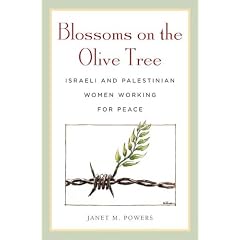
"Blossoms on the Olive Trees: Israeli and Palestinian women working for peace" by Janet M. Powers, Professor Emerita, Interdisciplinary Studies and Women's Studies , Gettysburg College.
- Hardcover: 184 pages
- Publisher: Praeger Publishers (March 30, 2006)
- Language: English
- ISBN-10: 027599001X
- ISBN-13: 978-0275990015


1 comment:
Me & Amal : Women question U.S. media coverage & 'We can live together...'
http://annies-letters.blogspot.com/2006/07/me-amal-women-question-us-media.html
'We can live together...'
http://www.cumberlink.com/articles/2006/07/23/news/news09.txt
By Joseph Cress, July 23, 2006
In the ancient city of Nablus, there is a beautiful old monastery with floor stones worn smooth by the passing of ages.
Visitors who come to the deep well in the sanctuary have to wait a long time to hear the bucket break the surface and draw water.
It is said Jesus Christ once rested there, promising the faithful living water to quench the thirst of any soul.
That day in ancient Palestine he was preaching to an enemy, a young woman from a rival tribe.
Normally Jews had no dealings with Samaritans, but Jesus spoke to her and shared his insight.
Nurse Amal Atieh Jubran felt uplifted just to taste water from Jacob's Well, wondering in the back of her mind how sanitary it was to drink from the cup of generations.
Nearby was a sight which torments her spirit -- a crowded refugee camp in modern-day Israel.
The tent city of 50 years ago has developed into a dense cluster of shacks crammed door to door, window to window.
Just speaking of it brings out a passion for her homeland for the half-Palestinian, half-Lebanese woman now living in East Pennsboro Township.
So much poverty. So much despair. Can there ever be hope?
Yet her name in Arabic means "many hopes" and she has lived with its pain and promise every day since moving to the United States in 1982.
Jubran, 58, says she wanted to raise her children away from violence and to live in freedom from what she sees as oppression carried out by the Israeli government.
Since 2001, she has been on six medical missions arranged through the Palestinian Children Relief Fund to assist surgical teams providing care.
"Muslim, Christian and Jew, we work hand in hand, shoulder to shoulder to make it better," Jubran says. "I've devoted my life to healing and helping people."
The latest mission, in May and June, took her to Nablus, Haifa and East Jerusalem, where she worked as an operating room nurse helping specialists from the U.S. and Mexico treat facial injuries.
She says an Israeli army soldier shot one child through the jaw while a different soldier kicked and stepped on another child.
Jubran adopted a 14-year-old boy she says was crippled by an Israeli army sniper who fired into a classroom, killing another youth.
Her hope is to save the next generation and for them to be free of occupation by Israeli forces.
"They are the future. They are the victims," Jubran says.
"They have no place to play ... Nothing to fill their minds," she adds. "Violence is all they see. If you take a child and let them draw a picture, what do you think they are going to draw -- flowers?"
She claims the Israeli government makes it difficult for Palestinian students to attend safe schools and as a result some children cannot even write their names.
Jubran says her team had to do some surgery without electricity using a flashlight or a cell phone and had to wait for hours at a security checkpoint even though she was on an humanitarian mission.
The most recent violence has put family members at risk. Her 81-year-old mother lives in Haifa, a target lately of Hezbollah bomb and rocket attacks.
"She has seen war before and is not afraid of it," Jubran says. "Her dream is to some day have independence and dignity for all. She wants to see light at the end of the tunnel."
Her mother does not really talk about conditions in Haifa.
"She's afraid her telephone may be wired," Jubran says. "She's just worried about her grandchildren."
Jubran has been calling her brother daily since the crisis began. He lives in a town in Upper Galilee, a region near the border of Israel and Lebanon under fire by both sides.
His three boys -- ages 10, 8 and 5 -- are not used to the sound of explosions out in the distance that shake the windows of their home.
"The family cannot go to school or work," Jubran says. "The children are not sleeping."
As she sees it, the Israeli government used the abduction of two soldiers from territory historically Lebanese as an excuse to launch attacks on civilian targets.
She adds Hezbollah is not made up of fighters from one religion, but several faiths under one banner, to fight what Jubran calls the "monstrous" Israeli war machine.
A long bloody history has led to a culture of segregation in Israel which has isolated segments of the population from the outside world, Jubran says. "It's like a big jail surrounded by Israel. It's the longest running refugee crisis in the world. It has to stop."
Jubran blames what she calls the Zionist government, claiming it never released maps of minefields laid during the May 2000 pullout from southern Lebanon -- putting adults and children in jeopardy.
She also believes Israel has defied United Nations resolutions not to fly warplanes over neighboring countries.
A native herself, Jubran has nothing against the Israeli people, noting many of her friends are Jewish along with some of the most outspoken critics of government policy.
She hopes one day the government would release the 10,000 prisoners -- mostly Palestinians -- being held in Israeli jails.
Her desire is for Israeli leaders to honor the right of five million refugees to return to their homeland and allow everyone to live in dignity and freedom under one country.
"Call it what you will ... Peaceland ... Messiah Land ... we can live together in the same area," Jubran says. "We do not need to be segregated.
"If we do not stop this war now, it is going to escalate and spread across the whole region," she adds.
Jubran does her part at home as a member of the Harrisburg Middle East Justice and Peace Group of people from both sides of the debate who meet monthly.
The group hosted a Palestine Film Festival at the Mid-town Cinema in Harrisburg last September.
Post a Comment